Generator
The type with a defined Sacral centre and no motor connected to the Throat: the builders, roughly seven people in ten. Human Design reads a type from the wiring of the chart, not from the planets' meanings, and this page is the reference for the commonest one.
What the tradition says
Human Design reads a Generator as a person whose working energy switches on in response to something real and stays on for as long as the work is right. The defined Sacral is the body's own engine, and the tradition's whole instruction is to let it answer: to wait for something to respond to rather than to initiate, and to trust the gut's sound over the mind's plan. Done that way, the tradition says, the signature is satisfaction, the plain feeling of a day's energy well spent.
The honest shadow is frustration, which the tradition names as the sign of a Generator initiating: effort going into work the body never said yes to, energy spent on the mind's ideas rather than the gut's responses, and a tiredness that sleep does not fix. The tradition does not soften this; a Generator who does not wait, it says, spends their whole force on the wrong things.
How the chart makes a Generator
There is a defined Sacral here, which is the body's own source of working energy. It switches on in response to something real in front of it and it does not switch on to order. The system reads this as a wiring built to respond rather than to initiate, which is why an idea thought up in the abstract so often fails to move, and the same idea, arriving as a question from someone else, moves immediately.
When it is running against its own design the signal is frustration: effort going into work the body never said yes to.
On an ordinary day
A Generator's strategy, waiting to respond, is not passivity. It is noticing that the body has answered a question before the mind has, and following the answer: the job that made the gut hum, the invitation that made it sink. The sound is the tell, and the tradition asks for it to be listened to before anything is decided.
What Western astrology cannot see: a decision mechanism
A Western chart says what a person is like. Human Design says how a Generator is built to decide, and the two are not the same question.
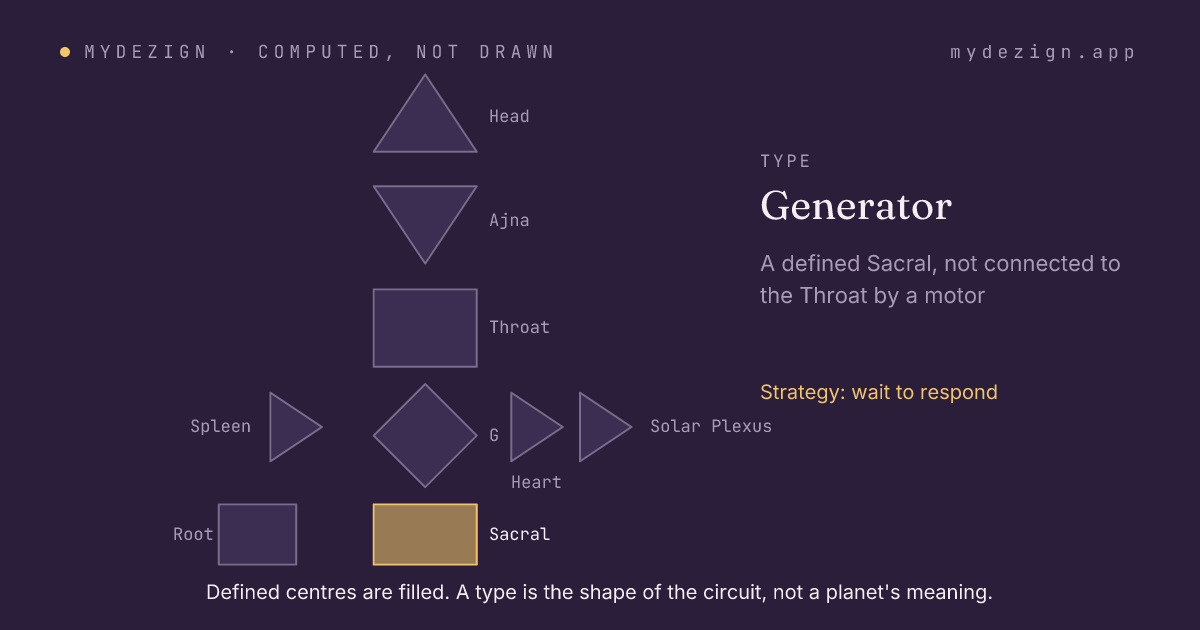
Western astrology has no type and no authority: nothing in a natal chart says wait to respond or inform before you act, because the tradition reads placements as qualities rather than as mechanics. Human Design takes the same moment of birth, and a second moment about eighty-eight days before it, and reads the sixty-four gates as wiring, so that a type is a type by the shape of the circuit rather than by any planet's meaning. That is why a person can have a Western chart full of fire and be built to wait. We show both, and where the strategy and the Sun sign pull in different directions we say so rather than choosing.
The mechanism is only as good as the birth time: the design side of the chart moves with it, and a defined centre can open with an hour's change. The calculator says which gates and channels carry the definition, and flags a chart that sits near a boundary.
About 60 seconds · needs your birth time and place · the design date is computed for you
Questions people ask
How do I know if I am a Generator?
From the bodygraph: a defined sacral, not connected to the throat by a motor. That needs the date, the time and the place of birth, since the design side of the chart is set about eighty-eight days before birth and every gate moves with the hour. The calculator draws it and names the type.
What is the strategy for a Generator?
Wait to respond. The tradition reads it as the one instruction that matters, its signature, satisfaction, as the sign it is being followed, and frustration as the sign it is not.
Is one type better than another?
No. The five are shares of the population, not ranks, and the tradition reads each as complete in itself. A page that says one type is rare and therefore special is selling something.
We read charts for pattern and coherence, not prediction. Nothing here tells you what will happen, and nothing here tells you who you are; it shows a structure and leaves the judgement with you.