Ingwaz
Ingwaz, the twenty-second rune: Ing, the seed. This page is the reference for the rune the poems read as gestation.
What the rune poems say
The Old English poem reads Ingwaz as Ing, first seen among the East Danes, who went over the wave with his wagon following. Read as a birth rune it is the seed, gestation, potential held until its time, and the quiet work that goes on before anything shows. It is the rune of what is not yet visible.
The honest shadow is the seed that never opens: potential held so long it rots, a withdrawal, and a completion always postponed. The modern reading says Ingwaz must come out of the ground.
The image
The seed, held in the ground. Nothing visible for a long time, then everything at once.
The meaning, as the site reads it
Gestation and stored potential. Ingwaz is the period before the result, when the work is real but invisible. It is the rune of things kept until they are ready, and of the sudden release when they are.
Born under it
You work slowly and privately and then produce something whole. You are hard to hurry and you do not like showing unfinished work. A steadiness, and a domestic contentment that does not need much witnessing.
The shadow: Waiting past ripeness. Potential held so long it becomes an identity rather than a stage.
As an hour rune: Someone who gives very little away on first meeting and a great deal on the third.
The thinnest layer here, and we say so
The birth runes are a modern arrangement, and this site labels them as one.
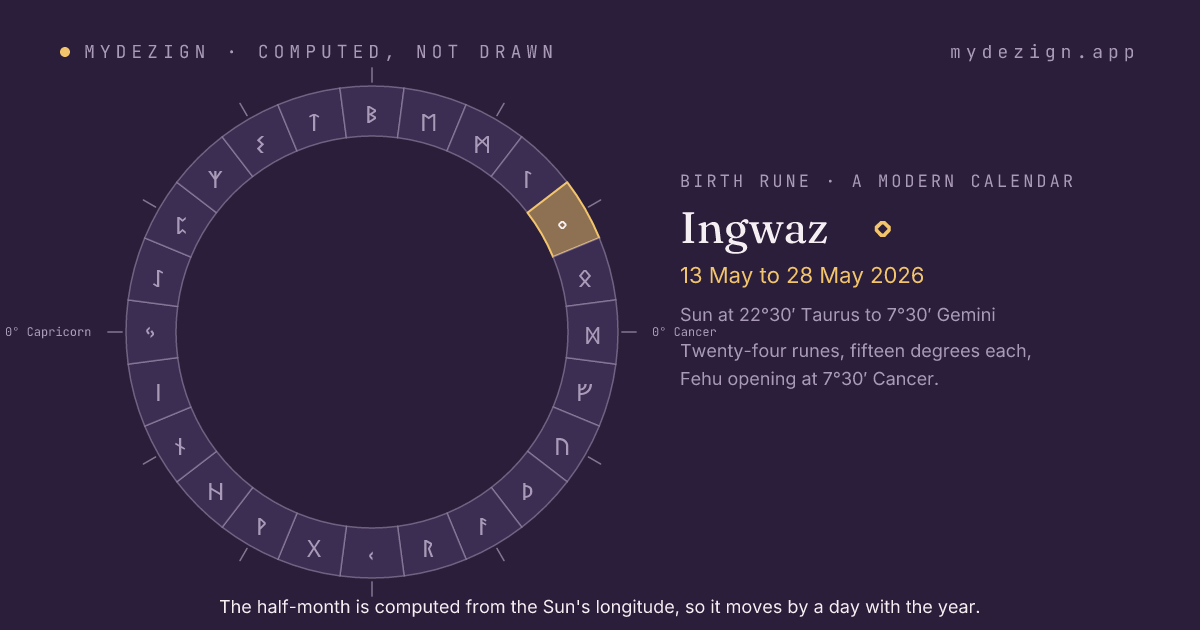
The Elder Futhark is old; the calendar that lays its twenty-four runes over the solar year at fifteen degrees each is Nigel Pennick's, from the late twentieth century, and nothing in the rune poems ties Ingwaz to 13 May. We compute the half-month from the Sun's longitude rather than from a printed table, so the window moves by a day with the year: this year Ingwaz runs from 13 May to 28 May, from 22°30′ Taurus of the tropical zodiac. That makes the birth rune a reading of the same Sun the Western sun sign reads, at twice the resolution and with a fraction of the tradition behind it, and the page says so.
We keep it because the poems are worth reading and because a thin layer honestly labelled is more useful than a thick one dressed up. Where it agrees with the sun sign it shares a Sun with, that is arithmetic, not a finding.
About 60 seconds · the half-month needs your date, the hour rune your time
Questions people ask
What are the dates for Ingwaz?
13 May to 28 May in 2026, by the Sun's longitude; a printed table can be a day out either side, which is why a birth within a day of the boundary is flagged by the calculator rather than assigned.
Is the birth rune traditional?
No. The runes are, and the poems that read them are medieval; the calendar of half-months is a modern arrangement, and the site says so on every rune page rather than dressing it as ancient.
What is an hour rune?
The same twenty-four runes laid over the day, Fehu opening at half past twelve, one rune an hour. The calculator reads yours from your birth time, and the tradition behind it is the same modern one.
We read charts for pattern and coherence, not prediction. Nothing here tells you what will happen, and nothing here tells you who you are; it shows a structure and leaves the judgement with you.