Shatabhisha
The twenty-fourth of the 27 lunar mansions, the layer of the Vedic sky that Western astrology does not have. Shatabhisha is the nakshatra of the hidden cure: its deity is Varuna, lord of the waters and of the law beneath things, its symbol is an empty circle, and its star is a faint one in the Water Bearer. The name means a hundred physicians, or a hundred stars.
What the tradition says
Shatabhisha's image is of the circle with nothing in it: what is hidden, what is secret, what heals from a distance. The classical texts read it as privacy, research, a drawing towards medicine and mystery, and an independence that keeps the crowd at a distance. Rahu rules the mansion, which gives the secrecy its appetite; this is a mind that wants to know what is not supposed to be known.
The honest shadow in the sources is the empty circle's isolation: loneliness chosen and then regretted, a suspicion of others that Varuna's severity brings, and a stubbornness about being reached. The texts say Shatabhisha people must learn that the hundred physicians cannot heal the one who will not be seen.
A Shatabhisha Moon
A Shatabhisha Moon describes a mind that keeps to itself: feelings that are private and hard to reach, comfort in research and in solitude, and a healing instinct that works best at one remove. Anyone born with the Moon here begins life in a Rahu period, and the sequence of their planetary seasons runs from there.
The four padas
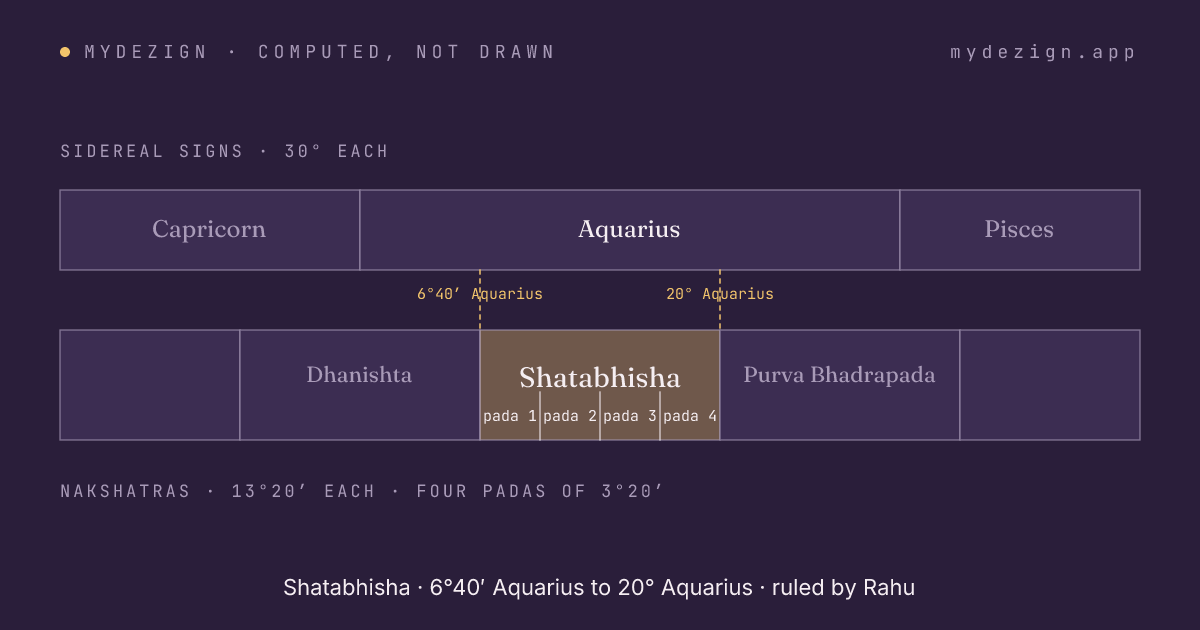
All four of Shatabhisha's padas fall in sidereal Aquarius. The navamsa runs Sagittarius, Capricorn, Aquarius, Pisces across them; the tradition reads the third, Aquarius within Aquarius, as the most detached and the most inventive, and the fourth, in Pisces, as the one where the healer's compassion is most felt.
In degrees: pada 1 from 6°40′ Aquarius to 10° Aquarius with a Sagittarius navamsa, pada 2 from 10° Aquarius to 13°20′ Aquarius with a Capricorn navamsa, pada 3 from 13°20′ Aquarius to 16°40′ Aquarius with a Aquarius navamsa and pada 4 from 16°40′ Aquarius to 20° Aquarius with a Pisces navamsa.
Why your Western chart never mentions this
There is no Western equivalent of Shatabhisha.
Western astrology divides the sky into twelve signs and stops. The Vedic system lays 27 mansions of 13°20′ over its twelve signs, a finer grain with its own deities, symbols and timing system. There is no Western equivalent of Shatabhisha, which is why a person can know their "big three" thoroughly and still meet something new the first time their Vedic chart is calculated. It is not that one system is finer-grained and therefore truer; they are answering different questions, and we show you both so you can see where they agree, and where they argue.
The Sun passes through Shatabhisha from about 19 February to 4 March each year, which Western astrology calls Pisces. A Moon can be here on any day of the year, since the Moon crosses a mansion in about a day, and it is the Moon the tradition reads first.
About 60 seconds · needs your birth date, time and place · unknown time handled honestly
Questions people ask
Is Shatabhisha a good nakshatra?
The tradition does not rank the mansions as good and bad; each carries a capacity and a cost, and Shatabhisha's are the gift of the hidden cure and the tax of isolation. Readings that call nakshatras lucky or unlucky are selling something.
What if my Moon is at the edge of Shatabhisha?
Then your pada matters more than usual, and your birth time matters more than usual, since the Moon moves about 13 degrees a day and crosses from Dhanishta into Shatabhisha and on into Purva Bhadrapada within two. The calculator shows your exact degree and flags it when a placement sits near an edge.
I am a Aquarius in Western astrology. Is Shatabhisha the same thing?
No. Your Western sign comes from the tropical zodiac; Shatabhisha is a sidereal mansion that lies inside sidereal Aquarius. You can be a Western Aquarius with no Shatabhisha placements at all, and a Western Pisces with a Shatabhisha Moon. The free chart shows your actual pair.
We read charts for pattern and coherence, not prediction. Nothing here tells you what will happen, and nothing here tells you who you are; it shows a structure and leaves the judgement with you.