Magha
The tenth of the 27 lunar mansions, the layer of the Vedic sky that Western astrology does not have. Magha is the nakshatra of the line you come from: its deities are the Pitris, the ancestors, its symbol is a throne, and its star is Regulus, the heart of the Lion and the brightest of the four royal stars. The name means the mighty.
What the tradition says
Magha's image is of inheritance: the throne that was somebody else's before it was yours, and the line of people standing behind you. The classical texts read it as dignity, a sense of tradition and duty to it, and a natural authority that the person did not have to earn from nothing. Ketu rules the mansion, which gives the inheritance its strangeness; what is handed down is not always what was asked for.
The honest shadow in the sources is pride of place: arrogance about where one comes from, a rigidity about how things have always been done, and a dependence on standing that leaves the person lost when it is gone. The texts say Magha people must learn that the throne is held in trust.
A Magha Moon
A Magha Moon describes a mind that carries its people: feelings organised around family, lineage and loyalty, a formality in how affection is shown, and a wound wherever respect is missing. Anyone born with the Moon here begins life in a Ketu period, and the sequence of their planetary seasons runs from there.
The four padas
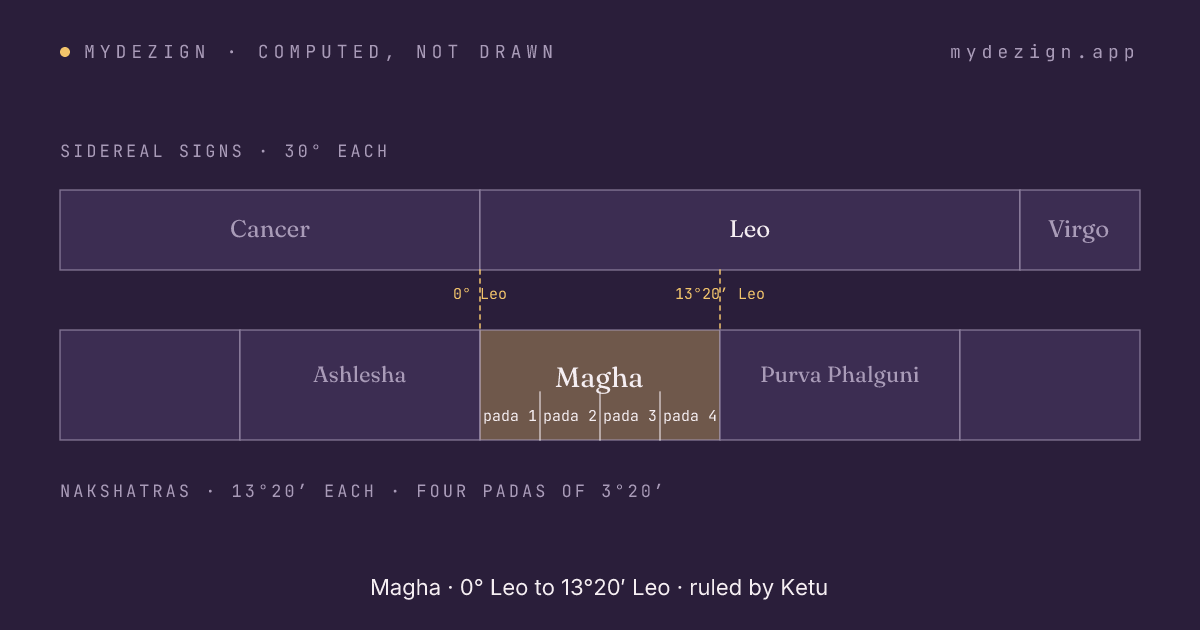
All four of Magha's padas fall in sidereal Leo. The navamsa runs Aries, Taurus, Gemini, Cancer across them; the tradition reads the first as the most commanding, and the fourth, in Cancer, as the one where the ancestors are felt as home rather than as rank.
In degrees: pada 1 from 0° Leo to 3°20′ Leo with a Aries navamsa, pada 2 from 3°20′ Leo to 6°40′ Leo with a Taurus navamsa, pada 3 from 6°40′ Leo to 10° Leo with a Gemini navamsa and pada 4 from 10° Leo to 13°20′ Leo with a Cancer navamsa.
Why your Western chart never mentions this
There is no Western equivalent of Magha.
Western astrology divides the sky into twelve signs and stops. The Vedic system lays 27 mansions of 13°20′ over its twelve signs, a finer grain with its own deities, symbols and timing system. There is no Western equivalent of Magha, which is why a person can know their "big three" thoroughly and still meet something new the first time their Vedic chart is calculated. It is not that one system is finer-grained and therefore truer; they are answering different questions, and we show you both so you can see where they agree, and where they argue.
The Sun passes through Magha from about 17 August to 30 August each year, which Western astrology calls Leo and Virgo. A Moon can be here on any day of the year, since the Moon crosses a mansion in about a day, and it is the Moon the tradition reads first.
About 60 seconds · needs your birth date, time and place · unknown time handled honestly
Questions people ask
Is Magha a good nakshatra?
The tradition does not rank the mansions as good and bad; each carries a capacity and a cost, and Magha's are the gift of dignity and the tax of pride. Readings that call nakshatras lucky or unlucky are selling something.
What if my Moon is at the edge of Magha?
Then your pada matters more than usual, and your birth time matters more than usual, since the Moon moves about 13 degrees a day and crosses from Ashlesha into Magha and on into Purva Phalguni within two. The calculator shows your exact degree and flags it when a placement sits near an edge.
I am a Leo in Western astrology. Is Magha the same thing?
No. Your Western sign comes from the tropical zodiac; Magha is a sidereal mansion that lies inside sidereal Leo. You can be a Western Leo with no Magha placements at all, and a Western Virgo with a Magha Moon. The free chart shows your actual pair.
We read charts for pattern and coherence, not prediction. Nothing here tells you what will happen, and nothing here tells you who you are; it shows a structure and leaves the judgement with you.