Eihwaz
Eihwaz, the thirteenth rune: the yew. This page is the reference for the rune the poems read as the tree that endures.
What the rune poems say
The Old English poem reads Eihwaz as the yew, a tree with rough bark, hard and fast in the earth, a keeper of fire and a joy on the land. Read as a birth rune it is endurance, the axis that holds between worlds, and a strength that comes from deep roots rather than from height. It is the rune of the bow and the tree it was cut from.
The honest shadow is the yew's poison: a defensiveness that keeps everyone at a distance, and a hardness that does not know when to yield. The modern reading says Eihwaz must bend, since the bow's whole use is in bending.
The image
The yew. Poisonous, extremely long-lived, and the wood a bow is made from.
The meaning, as the site reads it
Endurance and the axis a thing turns on. Eihwaz is the spine of a situation, the part that holds under strain, and the connection between what is above ground and what is not. Bows and coffins came from the same tree.
Born under it
You hold. You have a reliability that people build on, and a private acquaintance with difficulty that does not show. There is often an interest here in what most people avoid looking at: death, endings, what is underneath.
The shadow: Bearing things that should have been put down. Fixity, and a bleakness that becomes a habit.
As an hour rune: Someone who does not bend in a first meeting and does not need to.
The thinnest layer here, and we say so
The birth runes are a modern arrangement, and this site labels them as one.
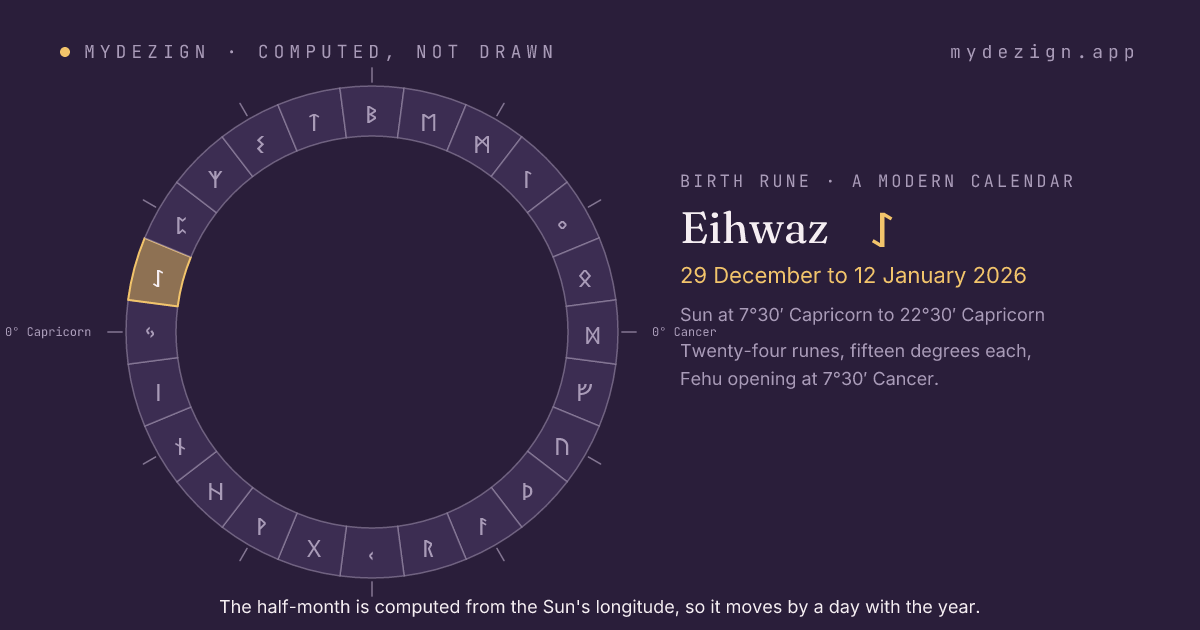
The Elder Futhark is old; the calendar that lays its twenty-four runes over the solar year at fifteen degrees each is Nigel Pennick's, from the late twentieth century, and nothing in the rune poems ties Eihwaz to 29 December. We compute the half-month from the Sun's longitude rather than from a printed table, so the window moves by a day with the year: this year Eihwaz runs from 29 December to 12 January, from 7°30′ Capricorn of the tropical zodiac. That makes the birth rune a reading of the same Sun the Western sun sign reads, at twice the resolution and with a fraction of the tradition behind it, and the page says so.
We keep it because the poems are worth reading and because a thin layer honestly labelled is more useful than a thick one dressed up. Where it agrees with the sun sign it shares a Sun with, that is arithmetic, not a finding.
About 60 seconds · the half-month needs your date, the hour rune your time
Questions people ask
What are the dates for Eihwaz?
29 December to 12 January in 2026, by the Sun's longitude; a printed table can be a day out either side, which is why a birth within a day of the boundary is flagged by the calculator rather than assigned.
Is the birth rune traditional?
No. The runes are, and the poems that read them are medieval; the calendar of half-months is a modern arrangement, and the site says so on every rune page rather than dressing it as ancient.
What is an hour rune?
The same twenty-four runes laid over the day, Fehu opening at half past twelve, one rune an hour. The calculator reads yours from your birth time, and the tradition behind it is the same modern one.
We read charts for pattern and coherence, not prediction. Nothing here tells you what will happen, and nothing here tells you who you are; it shows a structure and leaves the judgement with you.