Ansuz
Ansuz, the fourth rune: the god, the mouth, speech. This page is the reference for the rune the poems read as the source of language.
What the rune poems say
The Old English poem reads Ansuz as the mouth, the source of all language and the comfort of the wise; the Norse poems name it the god, Odin, and the estuary. Read as a birth rune it is inspiration, communication, the word that carries, and a talent for teaching and persuasion. It is the rune of breath made meaning.
The honest shadow is manipulation by speech: the gift used to deceive, a vanity about being heard, and a trickster quality the god's own name carries. The modern reading says Ansuz must mean what it says.
The image
The mouth. Breath becoming speech, and speech becoming counsel.
The meaning, as the site reads it
Language, teaching and the word that lands. Ansuz is communication as a form of power: what can be explained can be organised, and what can be named can be dealt with. It is the rune of the adviser rather than the actor.
Born under it
You think by talking and you are trusted with what people are working out. You explain well, often better than the person who knows the subject. Timing is part of the gift: knowing when a thing will be heard and when it will not.
The shadow: Talk instead of action. Persuasion used because it is easy, and cleverness mistaken for wisdom.
As an hour rune: Someone who arrives already speaking, and whose first instinct in any difficulty is to find the right words for it.
The thinnest layer here, and we say so
The birth runes are a modern arrangement, and this site labels them as one.
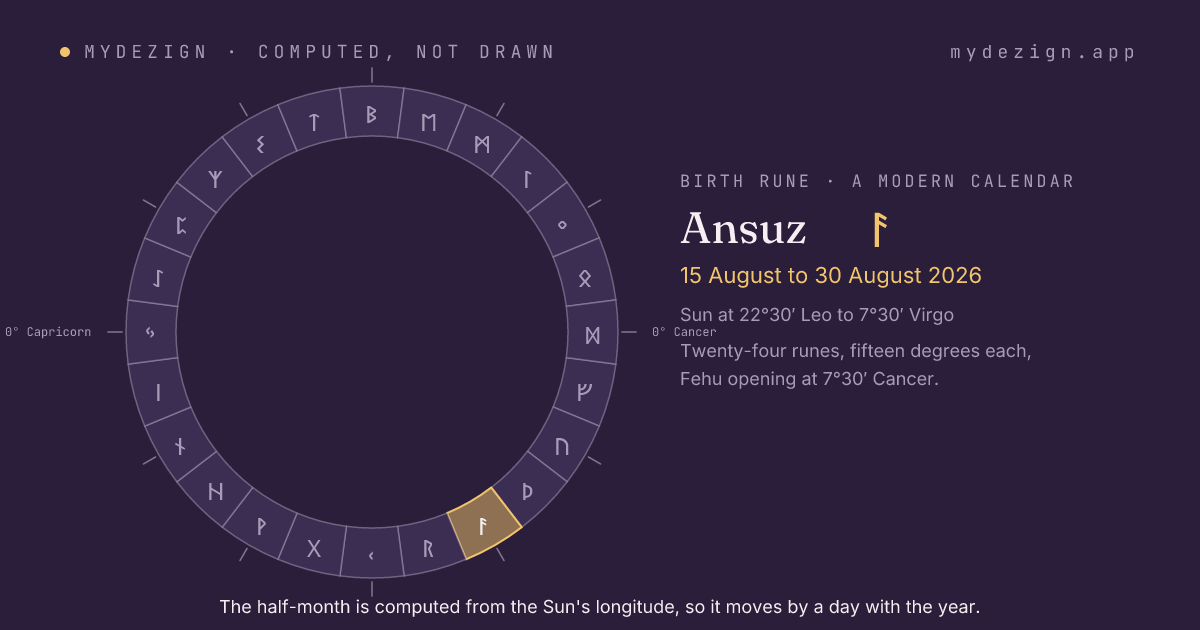
The Elder Futhark is old; the calendar that lays its twenty-four runes over the solar year at fifteen degrees each is Nigel Pennick's, from the late twentieth century, and nothing in the rune poems ties Ansuz to 15 August. We compute the half-month from the Sun's longitude rather than from a printed table, so the window moves by a day with the year: this year Ansuz runs from 15 August to 30 August, from 22°30′ Leo of the tropical zodiac. That makes the birth rune a reading of the same Sun the Western sun sign reads, at twice the resolution and with a fraction of the tradition behind it, and the page says so.
We keep it because the poems are worth reading and because a thin layer honestly labelled is more useful than a thick one dressed up. Where it agrees with the sun sign it shares a Sun with, that is arithmetic, not a finding.
About 60 seconds · the half-month needs your date, the hour rune your time
Questions people ask
What are the dates for Ansuz?
15 August to 30 August in 2026, by the Sun's longitude; a printed table can be a day out either side, which is why a birth within a day of the boundary is flagged by the calculator rather than assigned.
Is the birth rune traditional?
No. The runes are, and the poems that read them are medieval; the calendar of half-months is a modern arrangement, and the site says so on every rune page rather than dressing it as ancient.
What is an hour rune?
The same twenty-four runes laid over the day, Fehu opening at half past twelve, one rune an hour. The calculator reads yours from your birth time, and the tradition behind it is the same modern one.
We read charts for pattern and coherence, not prediction. Nothing here tells you what will happen, and nothing here tells you who you are; it shows a structure and leaves the judgement with you.