Aries rising
The sign on the eastern horizon at the moment of birth: the ascendant in Western astrology, the lagna in Vedic. It changes about every two hours, so it is the placement most sensitive to the birth time, and it is the frame the whole chart is read in.
What the Western tradition says
Western astrology reads an Aries ascendant as a person who arrives fast: the first impression is of directness, energy and a readiness to begin, and the body itself tends to be quick, lean and forward-leaning. Mars rules the chart, so the whole life is framed as a series of first moves. The tradition reads the rising sign as the vehicle rather than the driver: how the person meets the world before the Sun sign has decided anything.
The honest shadow is the same speed from the other side: impatience that others meet before they meet anything else, a bluntness on first contact, and a habit of starting the fight the rest of the chart did not want. The tradition keeps the courage and the collision together.
What the Vedic tradition says of the lagna
Meets things head on and at speed. The first move is usually made before the situation has been fully mapped, and the mapping happens while moving. That is the sidereal Aries, which is the rising sign of a different set of people from the tropical one; the section below says which.
The two-hour window
Aries is a sign of short ascension in northern latitudes: it rises quickly, in well under two hours in Britain, so an Aries rising is rarer there than the twelve-way split suggests and the birth time matters more than usual.
One sign, two ascendants
If Aries was rising in your Western chart, Pisces was probably rising in your Vedic one.
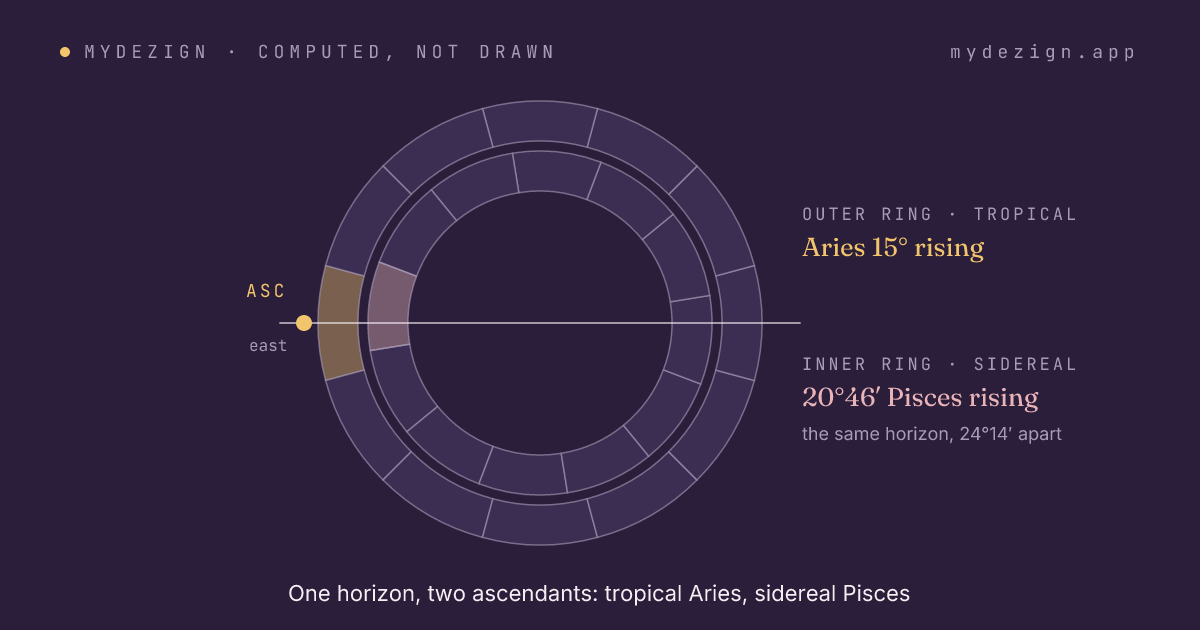
The ascendant is a degree of the zodiac, the one on the eastern horizon at the minute of birth, and the two zodiacs measure that degree from two starting points about 24.2 degrees apart. So the first 24°14′ of tropical Aries, which is 81 per cent of the sign, is sidereal Pisces; only a birth in the last 5°46′ of the sign, the last 19 per cent of the window, keeps Aries rising in both. That is the same shift as the sun signs, applied to the clock instead of the calendar, and it is why a Vedic astrologer and a Western one can look at one birth and name two rising signs without either being wrong.
The calculator shows both ascendants to the degree, and flags one that sits within a few degrees of a boundary, where an uncertain birth time would move it.
About 60 seconds · needs your birth time and place · unknown time handled honestly
Questions people ask
How do I find my rising sign?
From the date, the exact time and the place of birth: the ascendant moves about a degree every four minutes, so the time matters more than for anything else in the chart. The calculator gives it in both zodiacs, and an approximate time is handled as two candidate charts rather than a guess.
Is my rising sign more important than my Sun sign?
Western astrology reads the ascendant as the frame and the Sun as the centre, and Vedic astrology reads the lagna as the first house and the Moon before the Sun. Neither tradition has a single most important placement, and a page that names one is simplifying. The free chart shows all three together.
Why does my Vedic chart give a different rising sign?
Because the zodiacs are about 24.2 degrees apart. A tropical Aries ascendant in the first 24°14′ of the sign is a sidereal Pisces ascendant; both are the same horizon, measured from two starting points.
We read charts for pattern and coherence, not prediction. Nothing here tells you what will happen, and nothing here tells you who you are; it shows a structure and leaves the judgement with you.