4 · The Uninstructed
Gate 4 in Human Design, Gene Key 4, and hexagram 4 of the I Ching, The Uninstructed 蒙: one number, three traditions, read together on this page and kept apart where they differ.
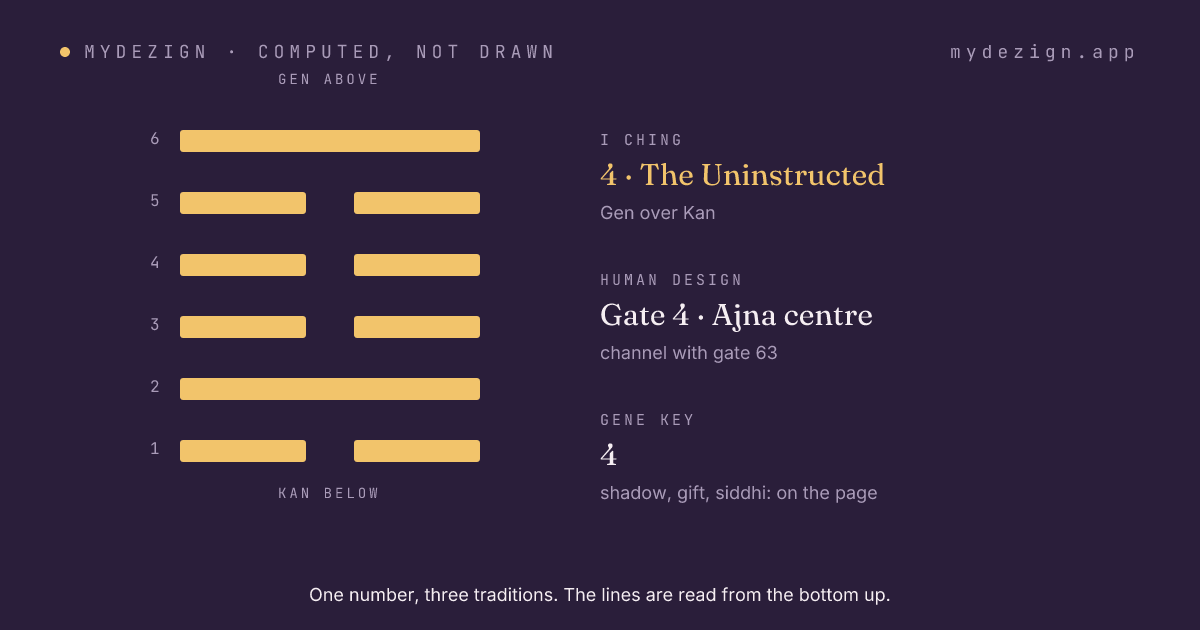
The number, read across the three
Human Design places gate 4 in the Ajna and reads it as formulisation: the mind that produces answers, formulas, explanations for the doubt that gate 63 raises. Gene Keys reads it as intolerance to understanding, the difference between an answer that closes a question and one that opens it. The I Ching calls it youthful folly, the young mind that must be taught and must ask.
The honest shadow is intolerance: answers held as certainties, an impatience with anyone who has not understood yet, and a mind that formulates to end the discomfort of not knowing. The tradition says gate 4's answers are for the mind's pleasure, not for decisions, and that treating them as authority is the folly the hexagram names.
The hexagram
The judgement: Not knowing yet, and it carries through. I do not go looking for the young fool; the young fool comes looking for me. Asked once, I answer. Asked a second and a third time, it is pestering, and being pestered I do not answer. It is worth staying straight.
The image: A spring coming out at the foot of the mountain, not yet knowing where it runs. So the person of worth carries what they start through to the end, and character grows from that.
The six lines
Line 1. To wake a fool up, it is worth using discipline, and then taking the shackles off. To go on with them still on. Humiliation.
Line 2. Take the fools in hand, with patience. Good fortune. Take a wife. Good fortune. The son can run the house.
Line 3. Do not take such a woman. She sees a man with money and loses hold of herself. Nothing here is worth doing.
Line 4. Foolishness that is boxed in. Humiliation.
Line 5. The young fool. Good fortune.
Line 6. Striking at foolishness. It is not worth becoming the raider; it is worth keeping raiders off.
In a Human Design chart
Gate 4 sits in the Ajna centre. Its channel partner is gate 63, in the Head centre. When both gates of a channel are activated, one from each end, the channel is defined and both centres with it, which is how the tradition builds a type and an authority. A gate on its own is a hanging gate: a theme without its circuit, and the tradition reads it as a pull towards whoever carries the other half.
Three traditions, one number
The same sixty-four figures, read three ways, and the three do not say the same thing.
Human Design took the sixty-four hexagrams of the I Ching and mapped them round the zodiac as gates, so that a planet at a degree is a planet in a gate; Gene Keys took the same sixty-four and read each as a spectrum from a shadow to a gift to a siddhi; the I Ching itself reads the figure as a situation, with a judgement, an image and six changing lines. Number 4 is formulisation in the first, intolerance becoming understanding in the second, and The Uninstructed in the third. They share a number and a diagram, and they were written for three different purposes, which is why we show all three rather than translating one into the others. The I Ching text on this page is our own English, made from the Chinese with the Wilhelm paragraph as a reading reference, and every passage carries its provenance.
Whether the number is in your chart at all is a Human Design question: the calculator says which gates your planets activate, on the personality side and the design side, and which of them complete a channel.
About 60 seconds · needs your birth time and place · both sides of the chart are drawn
Questions people ask
What does gate 4 mean in Human Design?
Formulisation, in the Ajna centre. Human Design places gate 4 in the Ajna and reads it as formulisation: the mind that produces answers, formulas, explanations for the doubt that gate 63 raises. Whether it is active in your chart depends on where your planets were at birth and about eighty-eight days before it.
What is Gene Key 4?
The same number read as a spectrum: the shadow of intolerance, the gift of understanding, the siddhi of forgiveness. Gene Keys reads the shadow as the starting point and the gift as what it becomes when it is met rather than fought.
Is hexagram 4 the same as gate 4?
The same figure and the same number, read for different purposes: the I Ching reads it as a situation you have cast or are in, Human Design as a fixed activation in a birth chart. A cast hexagram is not a natal gate, and the site keeps the two apart.
We read charts for pattern and coherence, not prediction. Nothing here tells you what will happen, and nothing here tells you who you are; it shows a structure and leaves the judgement with you.