Imox
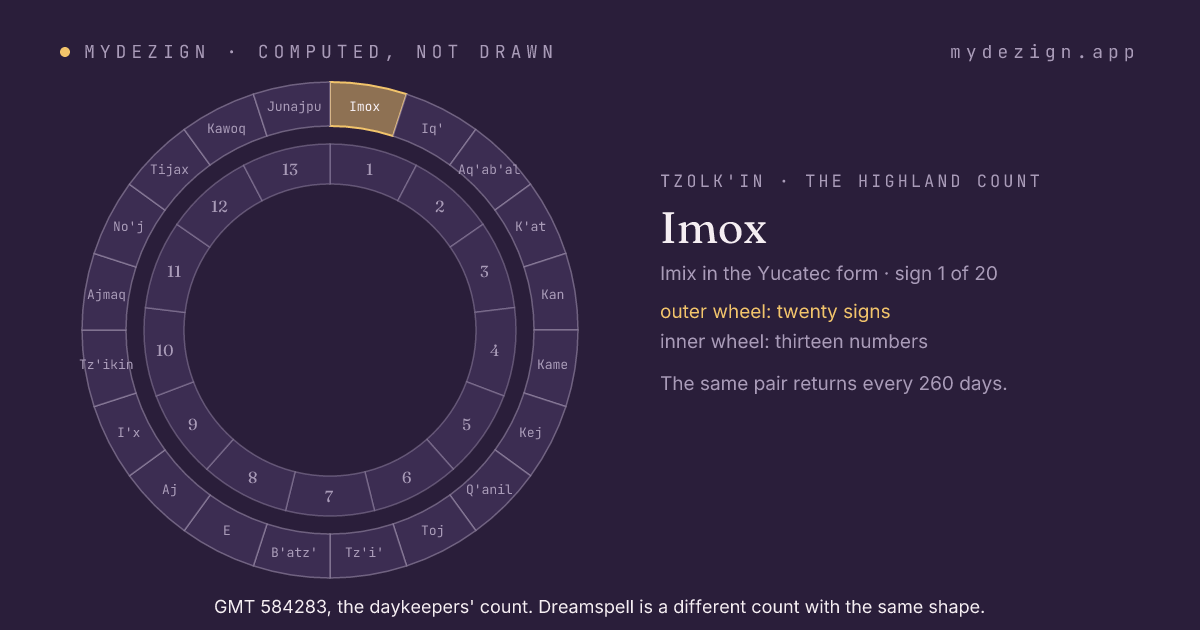
Imox, Imix in the Yucatec form: the first of the twenty day signs, the crocodile and the primordial waters. The Tzolk'in is a count of 260 days kept in the Guatemalan highlands without a break, and this page is the reference for its first sign.
What the daykeepers say
The daykeepers read Imox as the waters before anything was made: the left hand, the unconscious, rain and lakes, the mind and the unusual. A person born under it is read as sensitive, imaginative and unconventional, receptive to what other people do not register, and drawn to what lies under the surface. It opens the count, and the tradition treats it as the sign of beginnings that have not yet taken shape.
The honest shadow is the water's confusion: instability, a mind that runs away with itself, and a difficulty telling the vision from the drift. The tradition says Imox needs a shore, and that the sign is at its best with somebody steady beside it.
The meaning, as the site reads it
The primordial waters, the unconscious, rain and lakes, the mind and the unusual
Born under it
Sensitive, imaginative and unconventional, receptive to what others do not register
The shadow: Confusion, instability, a mind that runs away with itself
The trecena
Every 260 days the sign opens a trecena, a run of thirteen days that carries its name: the next 1 Imox is 10 October 2026. A birth on any day of the count is read with its number as the strength and its sign as the character, and the number is read from one, low and beginning, to thirteen, high and complete.
The two counts, stated honestly
Two apps can give one birthday two different day signs, and only one of them is this count.
This page follows the living highland count, kept without a break in the K'iche' and Kaqchikel communities of Guatemala and correlated to the Long Count by the GMT constant, 584283. Dreamspell, the count most apps use, was invented in 1990: it borrows the 260 day shape, renames the signs, skips leap days and runs about forty-four days apart, so the same person is a different sign in it. Neither app is wrong about its own arithmetic; they are counting different things, and only one of them is the count the daykeepers keep. We say which we use, and today is 11 Tijax in it.
The day turns at dawn for most highland daykeepers, not at midnight, so a birth in the small hours is flagged rather than silently assigned; the calculator does that, and it names the correlation it used.
About 60 seconds · needs only your date of birth · a birth before dawn is flagged
Questions people ask
What is my day sign?
The sign of your birth date in the 260 day count, worked out by arithmetic from the Julian Day Number rather than read off a table. The calculator gives the K'iche' and Yucatec names, the number, the direction, and the Mayan cross as one lineage reads it.
Why does another app give me a different sign?
Because it is probably Dreamspell, a count invented in 1990 that shares the 260 day shape and nothing else with the highland count: different names, no leap days, and a count about forty-four days apart. Both are consistent; only one is traditional, and this page says which it uses.
Is Imox a good day sign?
The daykeepers do not rank the twenty. Each carries a capacity and a shadow, both on this page, and the number it is paired with is read as its strength.
We read charts for pattern and coherence, not prediction. Nothing here tells you what will happen, and nothing here tells you who you are; it shows a structure and leaves the judgement with you.