28 · Great Excess
Gate 28 in Human Design, Gene Key 28, and hexagram 28 of the I Ching, Great Excess 大過: one number, three traditions, read together on this page and kept apart where they differ.
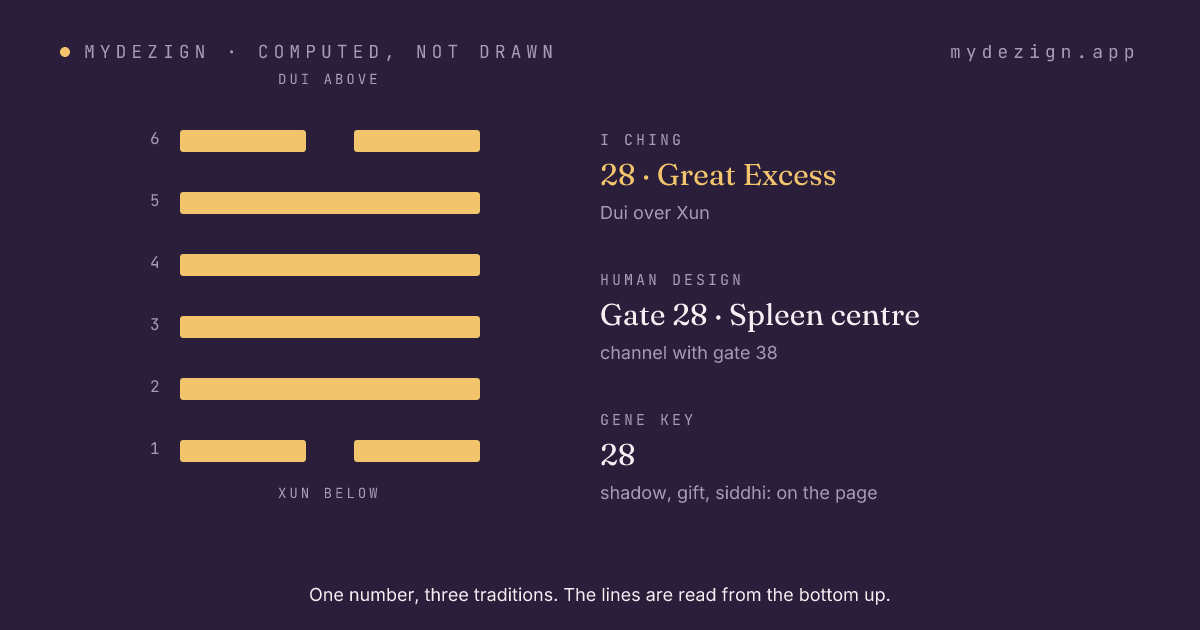
The number, read across the three
Human Design places gate 28 in the Spleen and reads it as the game player: the instinct that struggles to find what is worth living for, and that takes risks to find out. Gene Keys reads it as purposelessness to totality, the movement from a life that feels pointless to one lived completely. The I Ching calls it the preponderance of the great, the beam that bends under too much weight.
The honest shadow is purposelessness: struggle for its own sake, a risk-taking that is really a search for meaning, and a fear of a life that does not matter. The tradition says gate 28 with gate 38 is the channel of struggle, and that the struggle is the purpose only when it is chosen.
The hexagram
The judgement: The ridgepole sags. It is worth having somewhere to go. It carries through.
The image: The marsh goes over the tops of the trees. So the person of worth stands alone without fear, and turns away from the world without gloom.
The six lines
Line 1. Laid down on a mat of white rushes. No fault.
Line 2. A dry poplar puts out a shoot. An old man gets a young wife. Everything here is worth doing.
Line 3. The ridgepole sags. Misfortune.
Line 4. The ridgepole is braced up. Good fortune. If there is something else behind it, humiliation.
Line 5. A dry poplar puts out flowers. An old woman gets a young husband. No fault, and no praise either.
Line 6. Going too far into the water, and it closes over your head. Misfortune. No fault.
In a Human Design chart
Gate 28 sits in the Spleen centre. Its channel partner is gate 38, in the Root centre. When both gates of a channel are activated, one from each end, the channel is defined and both centres with it, which is how the tradition builds a type and an authority. A gate on its own is a hanging gate: a theme without its circuit, and the tradition reads it as a pull towards whoever carries the other half.
Three traditions, one number
The same sixty-four figures, read three ways, and the three do not say the same thing.
Human Design took the sixty-four hexagrams of the I Ching and mapped them round the zodiac as gates, so that a planet at a degree is a planet in a gate; Gene Keys took the same sixty-four and read each as a spectrum from a shadow to a gift to a siddhi; the I Ching itself reads the figure as a situation, with a judgement, an image and six changing lines. Number 28 is the game player in the first, purposelessness becoming totality in the second, and Great Excess in the third. They share a number and a diagram, and they were written for three different purposes, which is why we show all three rather than translating one into the others. The I Ching text on this page is our own English, made from the Chinese with the Wilhelm paragraph as a reading reference, and every passage carries its provenance.
Whether the number is in your chart at all is a Human Design question: the calculator says which gates your planets activate, on the personality side and the design side, and which of them complete a channel.
About 60 seconds · needs your birth time and place · both sides of the chart are drawn
Questions people ask
What does gate 28 mean in Human Design?
The game player, in the Spleen centre. Human Design places gate 28 in the Spleen and reads it as the game player: the instinct that struggles to find what is worth living for, and that takes risks to find out. Whether it is active in your chart depends on where your planets were at birth and about eighty-eight days before it.
What is Gene Key 28?
The same number read as a spectrum: the shadow of purposelessness, the gift of totality, the siddhi of immortality. Gene Keys reads the shadow as the starting point and the gift as what it becomes when it is met rather than fought.
Is hexagram 28 the same as gate 28?
The same figure and the same number, read for different purposes: the I Ching reads it as a situation you have cast or are in, Human Design as a fixed activation in a birth chart. A cast hexagram is not a natal gate, and the site keeps the two apart.
We read charts for pattern and coherence, not prediction. Nothing here tells you what will happen, and nothing here tells you who you are; it shows a structure and leaves the judgement with you.