10 · The Tread
Gate 10 in Human Design, Gene Key 10, and hexagram 10 of the I Ching, The Tread 履: one number, three traditions, read together on this page and kept apart where they differ.
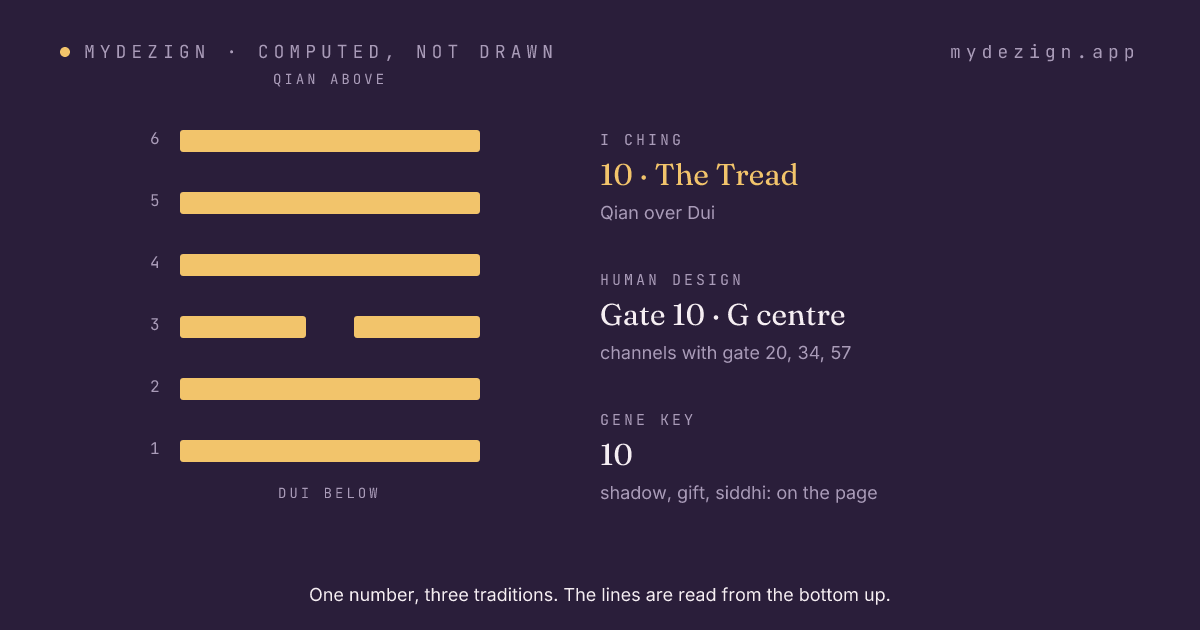
The number, read across the three
Human Design places gate 10 in the G centre and reads it as the behaviour of the self: how a person loves themselves, and how that self-love or its lack shows in conduct. Gene Keys reads it as self-obsession to naturalness, the movement from watching oneself to simply being. The I Ching calls it treading, conduct, walking on the tiger's tail without being bitten.
The honest shadow is self-obsession: a preoccupation with how one is coming across, a self-love that is really self-watching, and a behaviour performed rather than lived. The tradition says gate 10 has three channels, to the Throat, the Sacral and the Spleen, and that naturalness comes when the self stops supervising.
The hexagram
The judgement: Treading on the tiger's tail. It does not bite. It carries through.
The image: Sky above and marsh below. So the person of worth tells high from low, and people know where they stand.
The six lines
Line 1. Plain treading. Go on. No fault.
Line 2. Treading a level, open road. For someone who keeps to themselves, to stay straight is good fortune.
Line 3. A one-eyed man can see and a lame man can walk. He treads on the tiger's tail. It bites. Misfortune. This is a fighting man acting for his ruler.
Line 4. You tread on the tiger's tail. Go carefully, watch every step, and it ends in good fortune.
Line 5. Treading with your mind made up. Staying straight is dangerous here.
Line 6. Look back at how you have walked and weigh up the signs. If it comes full circle, good fortune from the source.
In a Human Design chart
Gate 10 sits in the G centre. Its channel partners are gate 20 in the Throat centre, gate 34 in the Sacral centre and gate 57 in the Spleen centre. When both gates of a channel are activated, one from each end, the channel is defined and both centres with it, which is how the tradition builds a type and an authority. A gate on its own is a hanging gate: a theme without its circuit, and the tradition reads it as a pull towards whoever carries the other half.
Three traditions, one number
The same sixty-four figures, read three ways, and the three do not say the same thing.
Human Design took the sixty-four hexagrams of the I Ching and mapped them round the zodiac as gates, so that a planet at a degree is a planet in a gate; Gene Keys took the same sixty-four and read each as a spectrum from a shadow to a gift to a siddhi; the I Ching itself reads the figure as a situation, with a judgement, an image and six changing lines. Number 10 is the behaviour of the self in the first, self-obsession becoming naturalness in the second, and The Tread in the third. They share a number and a diagram, and they were written for three different purposes, which is why we show all three rather than translating one into the others. The I Ching text on this page is our own English, made from the Chinese with the Wilhelm paragraph as a reading reference, and every passage carries its provenance.
Whether the number is in your chart at all is a Human Design question: the calculator says which gates your planets activate, on the personality side and the design side, and which of them complete a channel.
About 60 seconds · needs your birth time and place · both sides of the chart are drawn
Questions people ask
What does gate 10 mean in Human Design?
The behaviour of the self, in the G centre. Human Design places gate 10 in the G centre and reads it as the behaviour of the self: how a person loves themselves, and how that self-love or its lack shows in conduct. Whether it is active in your chart depends on where your planets were at birth and about eighty-eight days before it.
What is Gene Key 10?
The same number read as a spectrum: the shadow of self-obsession, the gift of naturalness, the siddhi of being. Gene Keys reads the shadow as the starting point and the gift as what it becomes when it is met rather than fought.
Is hexagram 10 the same as gate 10?
The same figure and the same number, read for different purposes: the I Ching reads it as a situation you have cast or are in, Human Design as a fixed activation in a birth chart. A cast hexagram is not a natal gate, and the site keeps the two apart.
We read charts for pattern and coherence, not prediction. Nothing here tells you what will happen, and nothing here tells you who you are; it shows a structure and leaves the judgement with you.