Yang Wood day master
Jia, the first of the ten heavenly stems: Yang Wood, the tree. In Four Pillars the stem of the day of birth is the self, and everything else in the chart is read as what supports it, drains it, or stands in its way.
What the tradition says
Four Pillars reads a Yang Wood day master as the tree: upright, principled, growing in one direction, slow to bend. The tradition associates it with integrity, a natural sense of how things should be, a protective habit towards the people beneath its branches, and an ambition that is about height rather than spread. It wants Water to feed it and sunlight, Yang Fire, to grow towards, and it puts down roots wherever it is planted.
The honest shadow is the tree's rigidity: a stubbornness that will break before it bends, a self-righteousness about the one right way, and a slowness to change course that can outlast the reasons for the course. The tradition says a Yang Wood chart with too much Metal in it is a tree forever being cut, and one with none is a tree that never becomes anything.
What supports it, and what it supports
Yang Wood is Wood. In the cycle of the five, Water produces Wood and supports it; Wood produces Fire and is drained by it; Wood controls Earth; and Metal controls Wood. A chart is read by counting which of the five is plentiful and which is missing around the day master, and the tradition's word for a good chart is not a strong one but a balanced one.
Water to drink, some Fire to grow towards, enough Earth to root in, and a little Metal to be shaped by. Too much Wood beside it and the forest crowds it; too much Metal and it is timber.
The image, as the site reads it
Yang Wood is the tree. It grows upward, slowly, in one direction, and does not bend easily to accommodate anyone.
Postcard versus reading, from the other side
Your year animal is the character everyone knows. Yang Wood is the one the tradition reads first, and hardly anyone knows theirs.
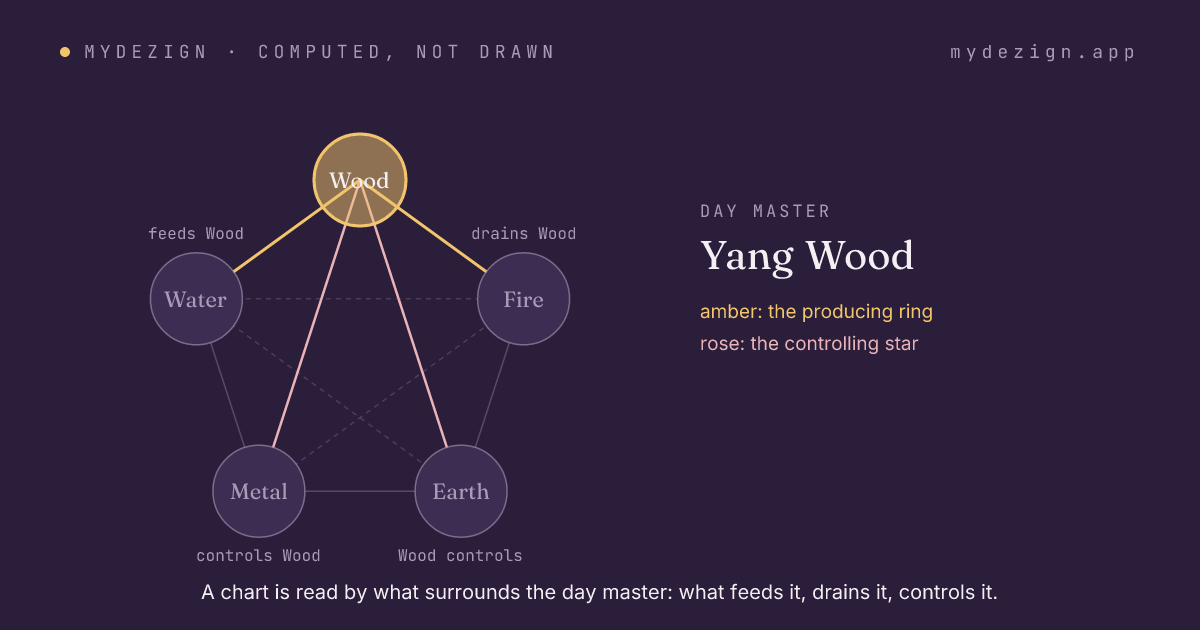
The year animal is the branch of the year pillar, shared by everyone born in the same twelve months. The day master is the stem of the day pillar, one of ten, and it changes every day, so it is the character of a birth rather than of a cohort. The tradition weighs the other seven characters against it: what feeds Yang Wood, what drains it, what it controls and what controls it. A Yang Wood born in a Dragon year and one born in a Rat year are read as the same self in different weather, and two Dragons with different day masters are read as different people who share a postcard.
The ten year luck pillars are read against the day master too: each decade's stem and branch is weighed as support or drain for Yang Wood, which is what the calculator's luck pillar section does once sex at birth is given.
About 60 seconds · needs your date, time and place · the four pillars are drawn for you
Questions people ask
How do I find my day master?
From the day pillar, which the calculator works out from your date and place of birth by the solar terms rather than the calendar. It is the stem, the upper character, of the day column, and it is the same for everyone born on that day anywhere in the world.
Is Yang Wood a strong day master?
Strength in Four Pillars is a reading of the chart around the day master, not a virtue of the stem: Yang Wood is strong when Water and Wood are plentiful in the other pillars and weak when Metal and Fire are. The tradition prefers balance to strength, and reads a strong day master with nothing to do as a burden.
What is the difference between Yang Wood and Yin Wood?
Same element, opposite polarity: the tree against the vine. The tradition reads Yang as the outward, forceful form of the element and Yin as the inward, flexible one, and it does not rank them.
We read charts for pattern and coherence, not prediction. Nothing here tells you what will happen, and nothing here tells you who you are; it shows a structure and leaves the judgement with you.